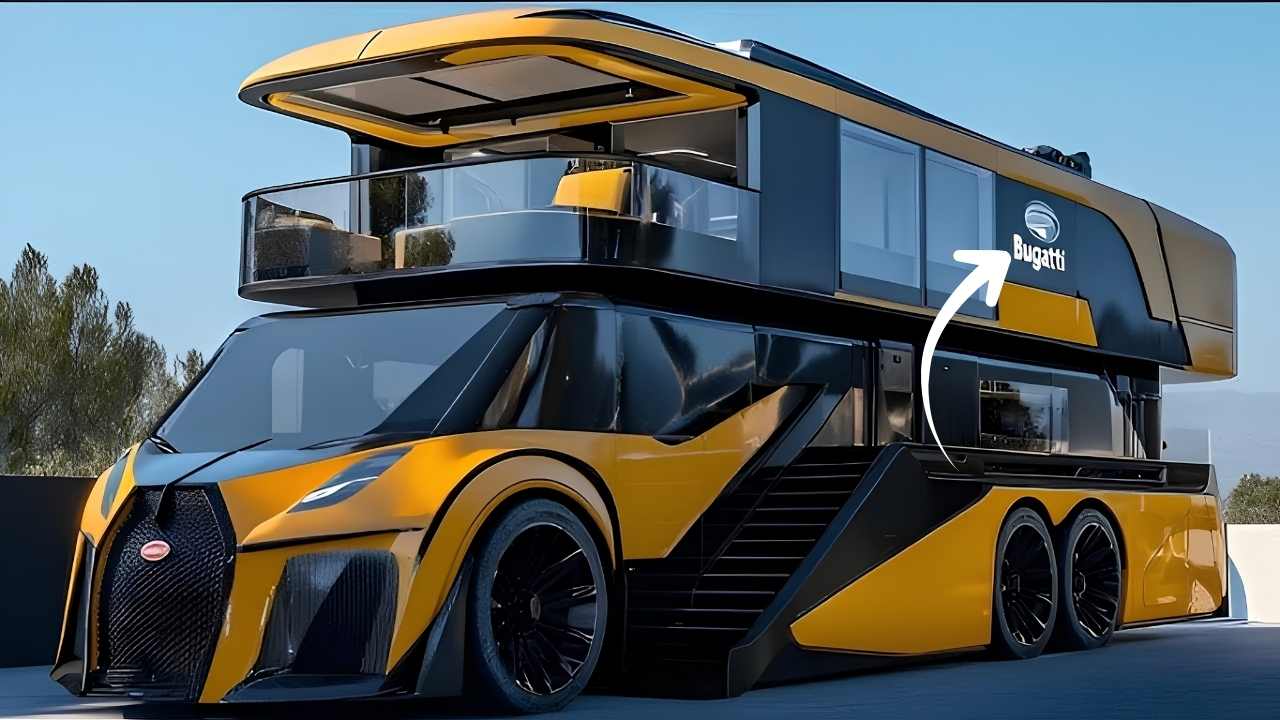
2026 Bugatti Motorhome : The idea of a 2026 Bugatti Motorhome facelift has captured attention across social media, video platforms, and automotive blogs in the United States.
The images are dramatic: a low-slung, carbon-fiber RV wearing Bugatti’s familiar horseshoe grille, surrounded by futuristic lighting, huge turbine-style wheels, and interiors that resemble a private jet or luxury penthouse.
However, American buyers and Bugatti fans should know one important fact before getting carried away: there is no verified official announcement from Bugatti confirming that it has built, revealed, priced, or scheduled production of a 2026 Bugatti motorhome.
Most material circulating online appears to be speculative digital artwork, independent concepts, or AI-generated visualizations rather than a factory-backed vehicle. Some creators openly label their videos as unofficial concepts made for entertainment, while others present imagined specifications that vary widely from one post to another.
That does not make the concept uninteresting. In fact, the popularity of these renderings says a great deal about the growing demand for ultra-luxury travel vehicles in the U.S. market.
It also raises a fascinating question: what would a genuine Bugatti-designed motorhome look like if the French hypercar brand ever entered the high-end RV world?
A Facelift Built Around Bugatti DNA
A believable facelift for a Bugatti motorhome would not simply put a badge on the front of a traditional Class A RV. It would need to reinterpret the brand’s famous design language for a much larger and taller vehicle.
The front end would likely be the first major talking point. Bugatti’s signature horseshoe grille could be stretched vertically and framed by sharp, slim LED headlights. Instead of a tall, flat windshield and boxy nose, the vehicle could use a swept-back cabin design, with a dark glass section flowing into a sculpted roofline.
This would give the motorhome a more planted and aerodynamic appearance, even though a vehicle of this size could never move through the air like a Chiron or Tourbillon.
A facelift might also introduce a stronger version of Bugatti’s familiar C-shaped side line. On a hypercar, that line creates a clear visual divide between the cabin and the engine area. On a motorhome, it could run from the front door toward the rear suite, using brushed aluminum, polished metal, or exposed carbon-fiber trim.
That single detail would help the vehicle look connected to the Bugatti family rather than like a conventional luxury coach with aftermarket styling.
The rear could receive a full-width LED light bar, a diffuser-inspired lower section, and carefully integrated vents to cool the powertrain and onboard electrical systems.
Large alloy wheels, likely designed with aerodynamics in mind, would be essential. Still, a real U.S.-spec motorhome would need to prioritize tire durability, braking performance, clearance, and stability over purely dramatic styling.
Cabin Luxury for Long U.S. Road Trips
The strongest case for a Bugatti motorhome would be made inside. A true flagship RV from the brand would need to feel more like a bespoke residence than a camper.
The entry area could feature illuminated steps, soft ambient lighting, leather-wrapped handrails, and a digital welcome display. From there, the main lounge could include curved seating, a concealed dining table, premium audio, and adjustable privacy glass.
Rather than copying the crowded look of many luxury RVs, Bugatti would likely favor a cleaner approach with fewer visible controls and more carefully selected materials.
Expectations would naturally include hand-stitched leather, aluminum trim, wood veneer, technical fabrics, and carbon-fiber accents. A blue-and-black color theme could honor Bugatti’s heritage, while customers might be offered near-limitless personalization for upholstery, embroidery, lighting, flooring, and exterior paint.
For American owners planning trips from California’s Pacific Coast Highway to Florida’s coastal routes or national parks in the Southwest, comfort would matter far more than top-speed claims.
A practical ultra-luxury layout could include a private bedroom, a spa-inspired bathroom, a chef-style galley, a work area, and a rear lounge that converts into a guest space.
The most valuable technology would be useful, not flashy. Features such as satellite connectivity, advanced climate control, intelligent lighting, energy monitoring, driver-assistance cameras, and a high-quality navigation system would make more sense than exaggerated claims about holograms or fully autonomous driving.
Performance Claims Need Caution
Online posts have attached wildly different powertrain claims to the supposed 2026 Bugatti Motorhome. Some describe a hybrid W16 setup, while others mention electric motors, extreme horsepower totals, enormous driving ranges, and acceleration figures that would be extraordinary even for a lightweight performance car. These claims should be treated as fictional unless Bugatti verifies them directly.
A real motorhome faces engineering challenges that do not exist in a hypercar. It must safely carry passengers, water, appliances, batteries, furniture, luggage, and potentially a tow vehicle or small recreational equipment.
It must also meet federal safety standards, manage heat, maintain predictable braking, and remain stable in crosswinds. For the U.S. market, it would also need to be practical enough for highways, fuel stops, service centers, and state-by-state road restrictions.
If Bugatti ever explored this category, a high-output hybrid system would be more realistic than an extreme top-speed machine. Electric motors could offer smooth low-speed power and silent operation in campgrounds, while a combustion engine or range-extending system could support long-distance touring.
Advanced air suspension and all-wheel drive would be equally important because they would improve comfort, traction, and control.
The point would not be to make the world’s fastest RV. It would be to make the most refined and technically ambitious grand-touring motorhome possible.
Why the Concept Is Trending
The viral appeal of a Bugatti RV comes from the contrast between two worlds. Bugatti represents rare hypercars, precision craftsmanship, and extreme performance.
Motorhomes represent freedom, long-distance travel, family vacations, and life on the open road. Blending those ideas creates an instantly shareable fantasy.
For affluent American buyers, the idea also fits the rise of luxury travel experiences. Private aviation, yacht ownership, custom coaches, and high-end overland vehicles are already established categories.
A Bugatti-branded motorhome would be an attention-grabbing extension of that lifestyle, especially for collectors who already own exotic cars but want a different way to travel.
At the same time, buyers should be skeptical of articles claiming official reveals, limited production numbers, U.S. allocations, deposit activity, or delivery dates without direct confirmation from Bugatti.
Search results reveal inconsistent reports, and several prominent videos explicitly state that the vehicle is an unofficial or AI-generated concept.
The 2026 Bugatti Motorhome facelift is therefore best understood as an exciting design fantasy rather than confirmed automotive news.
Also Read this – Maruti Alto 800 New facelift is launched, price is just ₹3.26lakh
If Bugatti ever turns that fantasy into reality, the result would likely focus on craftsmanship, effortless touring capability, advanced technology, and unmistakable brand identity—not unbelievable performance claims.